
 The Standard Group Plc is a multi-media organization with investments in media
platforms spanning newspaper print
operations, television, radio broadcasting, digital and online services. The
Standard Group is recognized as a
leading multi-media house in Kenya with a key influence in matters of national
and international interest.
The Standard Group Plc is a multi-media organization with investments in media
platforms spanning newspaper print
operations, television, radio broadcasting, digital and online services. The
Standard Group is recognized as a
leading multi-media house in Kenya with a key influence in matters of national
and international interest.


Born with Spina Bifida, Robert Kimotho’s early life was marked by struggles, including ridicule from classmates and limited access to mobility aids.
“I used to be carried on my mother’s back to and from school because at that time I wasn’t attending a special school; other children in school used to laugh at me,” he said, adding, “I didn’t understand why I was the way I was.”
Despite these obstacles, Kimotho, now a talented Kenyan wheelchair basketball player, has overcome significant challenges to represent his country on the international stage.
He has emerged as a prominent figure in Kenyan sports, inspiring others with his determination and resilience. His achievements underscore the importance of inclusivity and support for athletes with disabilities.
His message to young people with disabilities: “There are three P’s: patience, perseverance, and persistence. Don’t give up.
Children with disabilities across Kenya continue to face significant barriers in accessing appropriate mobility aids, despite wheelchairs being essential to their growth, independence, and inclusion.
According to the United Nations Children's Fund, one in ten children globally lives with a disability, yet access to assistive products such as wheelchairs remains as low as three per cent in some low-income settings.

Director of the Directorate of Disability Services at Kenyatta University, Dr Lubna Mazrui, said that stigma remains a barrier, with some families still hiding children with disabilities.
Awareness campaigns, she argues, are as important as fundraising.
“For children with disabilities, a wheelchair is far more than a mobility device. It is a gateway to education, play, social interaction, and participation in community life-key pillars of physical, emotional, and social development,” she said, adding, “Without appropriate mobility support, many children are excluded from everyday experiences that shape childhood and future opportunities.”
However, access to suitable wheelchairs remains limited due to challenges such as inadequate funding and a shortage of skilled professionals to conduct proper assessment, fitting, and follow-up support.
As a result, many children are left without wheelchairs or rely on poorly fitted devices that can compromise their health and well-being.

In response to these gaps, Bethany Kids Kenya has reaffirmed its commitment to ensuring that children with disabilities receive appropriate wheelchairs that meet World Health Organisation standards.
According to David Nganga, Country Director of Bethany Kids Kenya, the right wheelchair is critical in enabling children to participate fully in education, recreation, and social life.
“This was an idea from our assistive device technology team to raise awareness that a wheelchair is not just a chair with wheels,” said Ng’anga, “It is a prescribed device. It must meet the needs of the user, prevent harm and be serviceable locally.”
This commitment will be highlighted through the fourth edition of The Great Wheel, an annual advocacy initiative aimed at promoting access to appropriate wheelchairs and raising awareness on disability inclusion.
The event will take place from February 18 to March 1, 2026, and will bring together disability advocates, healthcare providers, government agencies, and community organisations.
The initiative is being organised in partnership with the National Council for Persons with Disabilities, Christian Blind Mission Kenya, Association of the Physically Disabled Kenya, Cheshire Disability Services Kenya, Walkabout Foundation, Free Wheelchair Mission, AGC Tenwek Hospital, Motivation Kenya and the County Government of Kakamega.
The project was flagged off in Kijabe, where six wheelchair users embarked on a symbolic journey wheeling their way to Kakamega.
The journey is intended to draw public attention to the lived realities of wheelchair users and to advocate for early access to appropriate paediatric wheelchairs.
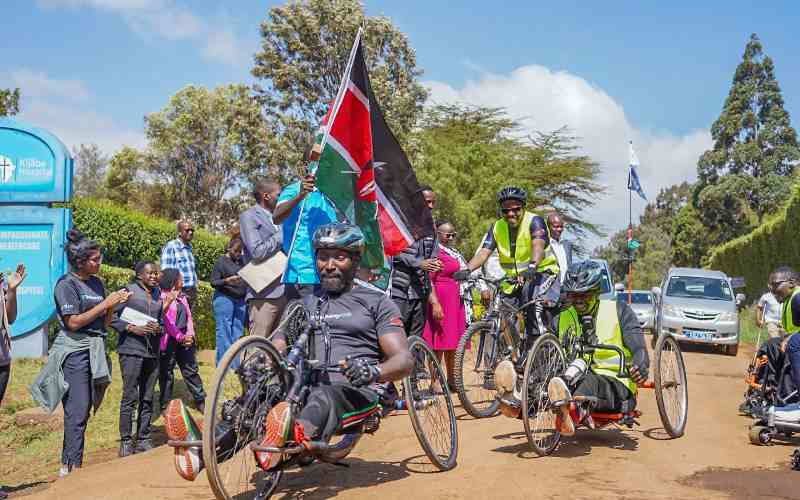
According to Dr Michael Munene, Executive director National Council of People Living with Disability (NCOWD), Kenya’s estimated need for assistive devices, especially wheelchair is staggering.
He revealed that 200,000 wheelchairs and other mobility devices are required annually. Yet government provision last financial year stood at about 4,700 devices, with a target of 5,000 this year.
This year’s Great Wheel places a special focus on children, highlighting the importance of early intervention and regular reassessment as children grow and their mobility needs change.
The initiative will culminate on March 1, 2026, with celebrations to mark International Wheelchair Day at Bukhungu Stadium.
The closing event is expected to bring together children with disabilities, caregivers, policymakers, and advocates to celebrate mobility, inclusion, and the right of every child to move freely and participate fully in society.
“We hope the campaign will strengthen public awareness, mobilise resources, and influence policies that prioritise assistive technology as a critical component of child health and disability inclusion in Kenya,” said Munene.







 join
join