
 The Standard Group Plc is a multi-media organization with investments in media
platforms spanning newspaper print
operations, television, radio broadcasting, digital and online services. The
Standard Group is recognized as a
leading multi-media house in Kenya with a key influence in matters of national
and international interest.
The Standard Group Plc is a multi-media organization with investments in media
platforms spanning newspaper print
operations, television, radio broadcasting, digital and online services. The
Standard Group is recognized as a
leading multi-media house in Kenya with a key influence in matters of national
and international interest.

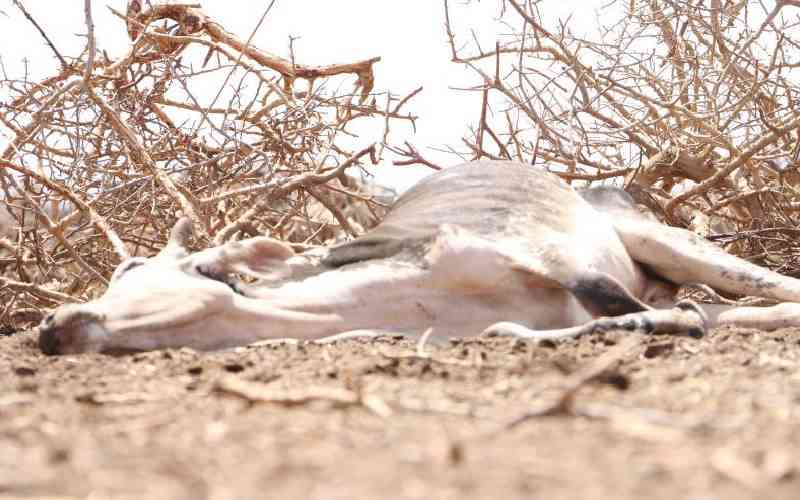
One evening last year, Ngugi, a farmer in Murang’a, noticed one of his animals lying on its side in the cowshed; its limbs stretched out and its eyes bulging.
Something is amiss, he thought to himself. True to his prediction, the animal was dying. He immediately thought of what to do and how to salvage it.
Losing the cow – a Friesian – would be too big a loss for a peasant farmer.
Ngugi, consulting a neighbour, called a local vet to assess the meat. After the animal was slaughtered a veterinary practitioner made some cuts into the meat. He looked at the cow’s stomachs and intestines. He checked the liver. Then he pronounced the beef fit for consumption.
“We proceeded to sell the meat at very friendly prices to villagers,” Ngugi told Health & Science earlier in the year.
In the village, beef is hard to come by. And so, the animal’s misfortune turned into ‘good tidings’ for the villagers. Four days later Ngugi and his family woke up to another dead cow. Coincidentally, it was a biological offspring of the earlier one.
“This time we called a veterinarian who works for the county government,” he says.
‘This is anthrax!’ the veterinarian pronounced immediately he saw the carcass. Laboratory tests confirmed the diagnosis.
It turns out the first village ‘vet’ was never a vet. While he had handled animals in distress before and injected some, he had no academic papers to match the expertise he claimed. When he learnt that authorities were coming to get to the bottom of the situation in the village, he took off and has never been seen again.
No sooner had the county government vet made the call than villagers began coming forward with sores that had developed on their fingers, arms, foreheads and other parts of the skin.
Anthrax is a zoonotic disease caused by the bacterium Bacillus anthracis. There are three main types of anthrax disease in human beings.
“Cutaneous anthrax is the most common the world over. The infection takes place through a cut or scrape on the skin,” Khadija Chepkorir, a veterinary epidemiologist at the Zoonotic Disease Unit (ZDU), said.
Then there is gastrointestinal anthrax, when infection occurs upon consumption of infected meat, milk or an edible animal product. And finally, there is inhalation anthrax, which occurs when one breathes in anthrax spores
“The inhalation form is the least common. But it is also the most dangerous form, killing nearly all of its victims,” Dr Chepkorir says.
Anthrax outbreaks in Kenya usually follow a familiar script: an animal that is sickly or dying is butchered to salvage the meat. The meat then becomes a meal for humans. Then symptoms of the disease start appearing in or on humans.
Animals with anthrax, Dr Chepkorir says, “die suddenly; with little to no symptoms.”
The animals get infected while grazing. Even so, the majority of human anthrax cases are associated with infections that originated from cattle.
During this festive season, a seemingly healthy animal that is suddenly dying might look like an enticing source of protein. And, of course, beef is the quintessential Christmas meal many a Kenyan would be craving. This is to warn you not to even think of it.
“Animals usually become infected through consumption of spores while grazing,” says Mathew Mutiiria, an infectious disease epidemiologist.
The bacteria survive naturally in soil as spores: a form that withstands heat and other extreme weather.
Humans get infected during close contact with infected animal carcasses or contaminated animal products
“On average the human skin has tiny microscopic wounds through which the anthrax bacteria gain entry,” says Dr Mutiiria.
But also, the bacteria can be manipulated in the lab and packaged in powder form for use by terrorists or criminals who want to cause harm.
Human anthrax case fatality rate in Kenya is 5.2 per cent. In other words, for every 100 Kenyans who become infected, five or six will die.
The map of anthrax-suitable zones reveals that the disease is prominent in agriculturally productive regions such as Murang’a, Nakuru, Bomet, Kakamega, Meru, Embu, Tharaka-Nithi, Kiambu and Kericho counties.
A great way to stem the possibility of an anthrax outbreak is by vaccinating the animals.
“Vaccination protects the animal from getting the disease,” Dr Chepkorir says. “If animals don’t contract it then humans, most likely, won’t be infected.”
Only licensed veterinary practitioners are allowed to handle vaccines. Farmers can then pay for the product and the service of vaccinating the animals. This is according to Dr. Alex Sabuni, the Managing Director and CEO at Kenya Veterinary Vaccines Production Institute (KEVEVAPI).
Be sure that the vet who will sell you and administer the vaccine is an actual vet.









 join
join