×

The Standard e-Paper
Home To Bold Columnists
 The Standard Group Plc is a
multi-media organization with investments in media platforms spanning newspaper
print operations, television, radio broadcasting, digital and online services. The
Standard Group is recognized as a leading multi-media house in Kenya with a key
influence in matters of national and international interest.
The Standard Group Plc is a
multi-media organization with investments in media platforms spanning newspaper
print operations, television, radio broadcasting, digital and online services. The
Standard Group is recognized as a leading multi-media house in Kenya with a key
influence in matters of national and international interest.

Audio By Vocalize
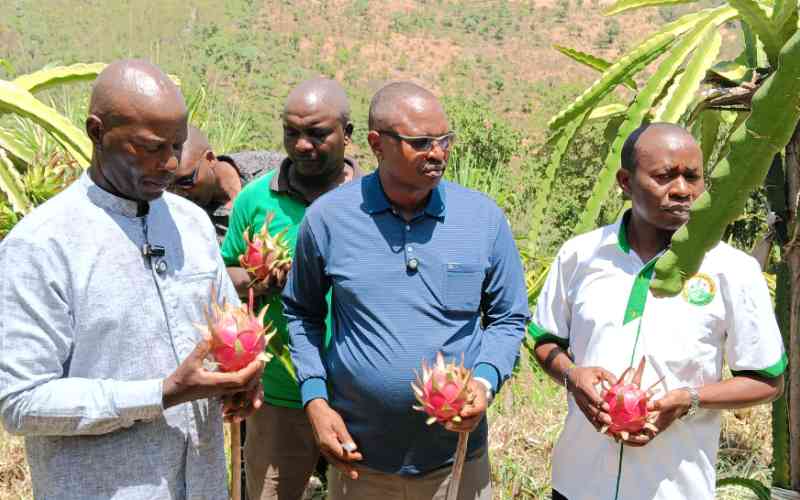
Experts say the dragon fruit, mainly cultivated in Vietnam, could be what Kenya needs to tackle the persistent drought in the country.
Many Kenyan farmers are unfamiliar with the dragon fruit, which thrives in a dry, tropical climate with average temperatures between 21 and 30 degrees Celsius and annual rainfall of 500-1500mm.
While several crops grow well under similar conditions, the dragon fruit stands out because it is currently a high-end product that few can afford, thanks to its nutritional and health benefits.
In Vietnam, the world’s largest producer, the dragon fruit generates about $1 billion (Sh129 billion) annually in exports, and stakeholders in Kenya believe that some parts of their climate are quite similar to Vietnam’s; therefore, there is no reason why Kenyan farmers should not adopt the crop.
The Kenya Plant Health Inspectorate Service (Kephis) recently introduced a new drought-resistant variety of dragon fruit to address food security and climate change. The Kika1 variety was developed by Antony Kinoti at Gravity Farm in Kathuura, Central Imenti, Meru County.
It was unveiled by Kephis chairman Joseph Eruaki. Eruaki and the deputy director for the Mount Kenya region, Geoffrey Malemba, presented the Certificate of Grant of Plant Breeders’ Rights to Gravity Farm CEO Kinoti.
A former director at the Meru Catholic Diocese’s development agency, heavily involved in agricultural development, stated that the fruit is recommended for diabetic and high blood pressure patients and others when taken with other products as advised by health experts due to its properties.
“I am urging farmers in Kenya that even if you don’t have a large farm, you can start with a quarter acre and plant 20 to 50 trees, or 100 if you can, and gradually increase. They (dragon fruit) are in the family of desert plants that grow in arid and semi-arid areas, so the water demand is very little,” Eruaki said.
Kinoti said the crop holds great potential, and it is time for Kenyans to recognise the opportunities it offers for food security and commercial growth. Kinoti will be the sole propagator and distributor of the variety, according to Eruaki.




Subscribe to our newsletter and stay updated on the latest developments and special offers!







 join
join