×

The Standard e-Paper
Fearless, Trusted News
 The Standard Group Plc is a
multi-media organization with investments in media platforms spanning newspaper
print operations, television, radio broadcasting, digital and online services. The
Standard Group is recognized as a leading multi-media house in Kenya with a key
influence in matters of national and international interest.

Audio By Vocalize
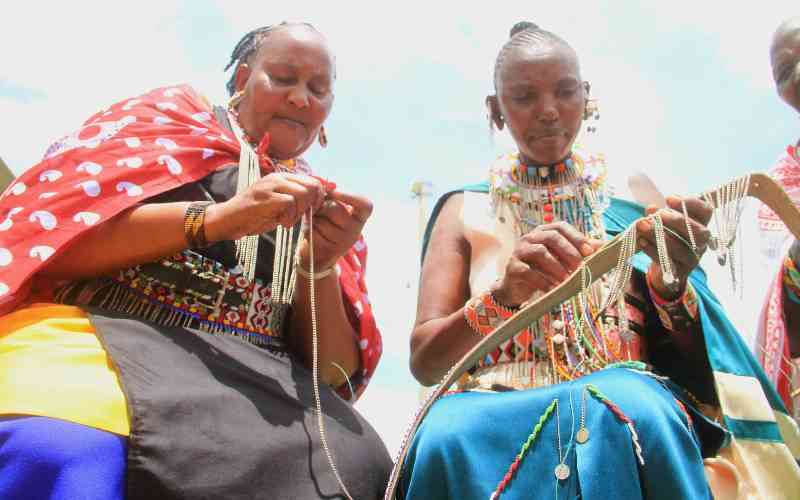
Maasai women engage in their beadwork trade in Narok County. [Peterson Githaiga, Standard]
It is a major relief for hundreds of Maasai women who sell their beadwork at the entrance of the Maasai Mara National Reserve in Narok County, following the construction of a multi-million-shilling market.
And as tourist vehicles approach Sekenani Gate, the main entrance to the Maasai Mara National Game Reserve, a colourful but increasingly desperate contest for customers unfolds.
Women clutching bundles of brightly coloured Maasai beadwork spring into action, racing alongside the vehicles and waving their wares at tourists in a frantic attempt to secure a sale.
So aggressive is the competition that some come dangerously close to moving vehicles, risking being knocked down in pursuit of a potential customer.
For these women, every passing vehicle represents a possible source of income, and every tourist who drives past without stopping is a missed opportunity to put food on the table.
On either side of the gate, the scene is equally telling. Some women are busy weaving intricate necklaces, bracelets, earrings and other traditional ornaments, while others sit beneath the shade of trees, waiting patiently for prospective buyers.
It is mid-morning, yet business is already bustling with activity.
Away from the usual hustle, however, Sekenani is preparing for this year's Annual Maa Cultural Festival. Trucks take turns offloading construction materials as workers put finishing touches to preparations for the event.
The most conspicuous development is a newly constructed market intended to give women beadworkers a permanent and organised place to display and sell their products.
During The Standard's recent visit to the place, officials said the facility is more than 97 per cent complete and is expected to be officially opened by President William Ruto on November 10, when the five-day cultural event kicks off.
A short distance away, inside a nearby church compound, dozens of women have gathered for a meeting to prepare for the festival and discuss the opportunities presented by the event and the new facility.
For Helen Muntet, chairlady, Siana Ushanga Cooperative from Ngoilele sub-location, Narok West, the market represents a significant shift from years of struggling to sell their products individually.
"We are very happy to have this market. Women from across Siana Ward will benefit because we will finally have a place where we can sit, work and sell our products," she says.
Stay informed. Subscribe to our newsletter
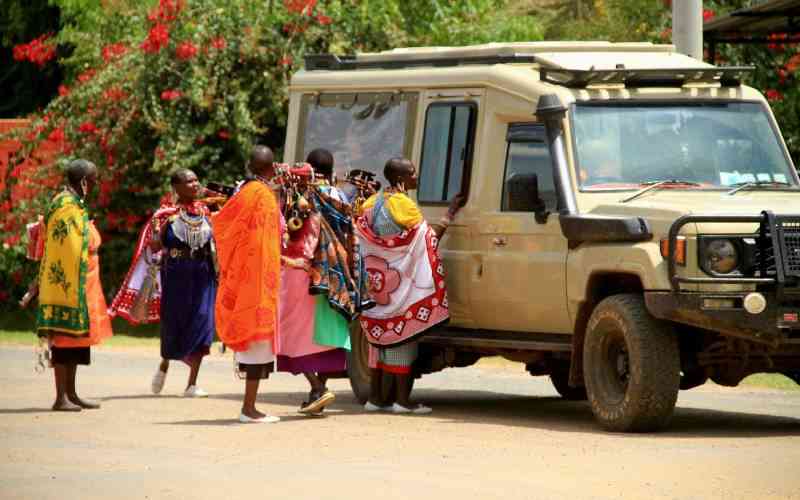
Maasai women rush to sell their beadwork to tourists at Sekenani Gate, Maasai Mara, Narok County. [Peterson Githaiga, Standard]
For years, the women have operated in an informal and highly competitive environment where individual sellers often undercut one another to secure a sale.
Muntet says some would sell an item for as low as Sh500 even when another woman had priced a similar product at Sh1,000, simply because they desperately needed money to take home.
The practice not only undermined their earnings but also weakened their bargaining power with tourists.
"Sometimes one woman would sell an item for Sh1,000 while another would sell the same thing for Sh500. Tourists would question why there was such a difference and eventually buy from the cheaper seller. We ended up competing against one another, with some making losses," she tells The Standard.
According to them, the facility is expected to introduce uniform pricing, collective marketing and a more organised selling arrangement.
But beyond providing a physical space, Muntet says the facility will give women something they have lacked for years: time to concentrate on improving their craft.
"Now we will have somewhere to sit, weave and concentrate on making our products. We will display our items on shelves with price tags, and customers can choose what they want. We will no longer have to keep looking out for vehicles or run after tourists," she says.
She hopes the improved working environment will allow them to produce higher-quality beadwork capable of competing in wider markets, including international ones.
For the women, beadwork is not merely a cultural expression or a supplementary activity. It has become an important source of household income and a pathway to greater financial independence.
Muntet says proceeds from their work have helped women pay school fees, provide food for their families and acquire livestock.
"Beadwork has helped us support our families. We pay school fees, provide food and even buy livestock. Some of us who previously owned only goats can now hope to acquire cattle. We are also educating our children, including taking them to university," she says.
Rebecca Senui, the Narok County coordinator in charge of beadwork, notes that nearly 1,500 women across the county are involved in the craft, most of them organised in groups and cooperatives.
She says the absence of a central selling point has exposed women to exploitation, unpredictable earnings and unsafe working conditions.
"They come in the morning and return home in the evening, sometimes without making a sale. They have been working under the sun and running for shelter whenever it rains. They also face the danger of wild animals because they operate near the reserve," she says.
She is optimistic that the new market will allow women to leave their products for sale even when they cannot physically be present.
A proposed information and communications technology hub will further open up opportunities for online marketing, allowing customers from across Kenya and abroad to view and order their products.
"Someone in another country will be able to see what these women make, place an order and have the products delivered. The women will no longer have to depend entirely on tourists visiting the reserve," Senui says.
The facility will also include a childcare centre, an intervention she says could help mothers balance production and childcare responsibilities.
For Senui, the transformation is particularly important in a community where women are increasingly using their earnings to support household decisions.
She says the income has enabled some women to purchase water tanks, reducing the need to travel to rivers and exposing themselves to dangers posed by wild animals.
The International Labour Organisation (ILO), through its Public-Private Development Partnership (PPDP), is implementing the project through a partnership with, ForumCiv and county governments, with a focus among the organisations supporting the initiative.
Isaac Muema, the ILO project manager for PPDP, says the project is focused on creating decent work and expanding economic opportunities for women and young people.
This, he says, is anchored in addressing market constraints that limit economic opportunities for women and young people.
The project, which began in 2018 and entered its current phase in 2024, uses a market systems development approach to connect communities with private-sector opportunities.
Funded by the Swedish International Development Cooperation Agency (Sida), the initiative brings together county governments, businesses, civil society organisations and communities to identify and address barriers to economic participation.
Muema says the Sekenani market will provide a central platform where women can showcase their products, access training and improve quality through value addition.
"It is an excellent hub for women to showcase the products they have been producing. It will also allow partners to promote value addition so that these beadwork products become marketable and respond to the standards and demands of the market," he says.
However, the women say a building alone will not transform their fortunes without deliberate investment in the tools and resources needed to sustain production.
Senui says access to raw materials remains a major challenge, with quality beads often unavailable locally and women forced to travel to Nairobi to purchase supplies at considerable cost.
She is appealing to the national and county governments, development partners and private-sector players to provide working capital, materials, machinery, training and access to external markets.
"We have the building, but if we do not have materials to work with, it will be of little benefit. We need support to acquire beads, machines and other equipment, as well as training to improve the quality of our products," she says.
Muema says the ILO's approach will also involve connecting the women to financial institutions, larger enterprises and entrepreneurs who can support business incubation and access to finance.
Titus Kuria Mbugua, a programme manager at ForumCiv, says the organisation has focused on ensuring that the women benefit fairly from economic opportunities in the tourism value chain.
“Our work has been to support the creation of decent jobs that are rights-based. For the project that the county government of Narok is developing for women within the Ushanga initiative, we have been supporting the integration of equal benefit-sharing mechanisms for women,” he says.
According to him, ForumCiv has facilitated dialogue between women, their cooperatives, leaders and the county government to ensure that their concerns are reflected in the design and management of the initiative.
One of the issues raised during these engagements is childcare, which he says is critical to allowing women to participate fully in business.
“By alleviating part of the care responsibilities of women, it means they have more time and are able to focus on doing their business. That leads to more income, and that income translates also to business growth,” he says.
He says the initiative is part of the second phase of the Public-Private Development Partnership (PPDP), jointly developed with the county governments of Narok and Nakuru, the ILO, ForumCiv and ILO social partners.
Kuria says the project has adopted a market-systems approach, with sustainability at its centre. The aim, he says, is for private-sector players and county governments to continue supporting the women beyond the project's facilitation period.
He cites the Ushanga initiative as an example of how development partners can work with county governments to develop programmes that are eventually incorporated into local development plans.
For these women, the ambition is bigger than finding a sheltered place to sell necklaces and bracelets.
It is about moving from roadside hawking to organised enterprise, from competing against one another to negotiating collectively, and from depending on passing tourists to accessing wider markets.




Subscribe to our newsletter and stay updated on the latest developments and special offers!