×
App Icon
The Standard e-Paper
Stay Informed, Even Offline
★★★★ - on Play Store
Download App

Motoring: The Thermostat myth that refuses to die

Vocalize Pre-Player Loader

Audio By Vocalize

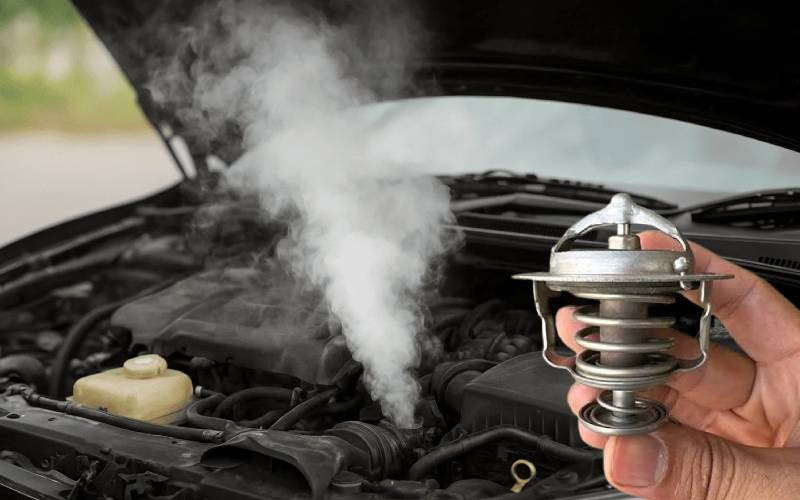
A thermostat helps maintain the engine within its intended operating temperature range.

There has been a raging debate, both online and offline, over whether vehicle owners should remove the engine thermostat from their engines.

This week on Motoring, we delve into the debate to determine whether the pros of running a petrol or diesel engine without the inexpensive device outweigh the cons, and whether it plays a far bigger role than its size suggests.


Most car manufacturers fit engines with a thermostat with an aim of aiding the engine to warm up quickly, regulate operating temperature, reduce wear and, above all, improve fuel efficiency.

The thermostat is usually located at the point where coolant leaves the engine and enters the upper radiator hose. Its housing is attached to the cylinder head or engine block. 

Thermostat explained

A vehicle thermostat is a temperature-sensitive valve fitted into the engine’s cooling system. Its main job is to control the movement of coolant between the engine and the radiator.

When an engine is cold, the thermostat remains closed. This limits the flow of coolant to the radiator and allows the engine to warm up quickly.

As the coolant reaches the thermostat’s calibrated opening temperature, often between 80°C and 95°C, the thermostat begins to open. 

Hot coolant is then allowed to flow to the radiator, where heat is released into the surrounding air before the cooled liquid returns to the engine.

The myths around a thermostat

Locally, there exists a long-standing belief among some motorists and mechanics that a thermostat is unnecessary because the weather is already hot and that removing it will make an engine run cooler.

"It is a misplaced myth since automotive engineers design the thermostat for the temperature inside the engine and not simply for the temperature outside the vehicle," Evans Odhiambo, a mechanic based at Baricho Road, Nairobi, argued.

His sentiments were echoed by Christopher Anyembe, an automotive engineer who explained that a thermostat does not merely prevent overheating. 

It helps maintain the engine within its intended operating temperature range.

"The thermostat actually contributes to faster warm-up, reduced engine wear, improved fuel economy and lower emissions," Anyembe stated.

According to information shared on the Toyota Motor Corporation website, the thermostat is meant to open progressively, adjusting coolant flow according to engine temperature. 

"This allows the cooling system to maintain a relatively stable operating range rather than constantly swinging between too hot and too cold," the information states.

How the thermostat works

Thermostats use a sealed wax element. As the engine warms up, heat causes the wax to expand and, as a result, pushes against a small piston or rod, which opens the thermostat valve.

Alternatively, when the coolant temperature falls, the wax contracts and a spring helps return the valve towards the closed position.

Most modern vehicles may also use electronically controlled or map-controlled thermostats. 

"Such engines can be influenced by the Engine Control Unit (ECU) to manage temperature more precisely under different driving conditions. For example, during sudden and heavy acceleration, or high engine loads," Evans explained.

Better fuel economy?

A cold engine may use more fuel because the engine management system adjusts fuel delivery during warm-up.

"If a thermostat is missing or stuck open, coolant may circulate through the radiator continuously, making it difficult for the engine to reach its intended operating temperature," Dickson Musungu, a mechanic at Auto Express, weighed in.

The result may be increased fuel consumption, particularly during short trips or cool mornings. When an engine remains cold for long periods, the oil may not flow or protect components as effectively as it does at normal operating temperature.

"Repeated cold operation may also build moisture and fuel contamination in the oil, contributing to sludge formation and increased wear over time," Musungu added.

Can an engine run without a thermostat?

Both mechanics confirm that most vehicles they have worked on have had the thermostat removed.

"Any engine can physically run without a thermostat, but “running” is not the same as “running correctly.”"Evans clarified.

With the thermostat missing, coolant may circulate through the radiator from the moment the engine is started. 

"Removing the thermostat may also hide the real cause of an overheating problem rather than fixing it," Christopher warned.

At a Baricho Road garage, we met Michael, who owns a Nissan X-Trail T30. Despite running effectively without a thermostat for two years, he stated that it has cost him expenses he would have avoided.

"There was once this vehicle overheated because of a clogged radiator and failing water pump. I was advised to remove the thermostat before the car was properly diagnosed. I ended up replacing both the radiator and water pump and fixing the leaking head gasket," he explained.

Why most opt to remove the thermostat

It is often linked to repeated overheating of an engine. By removing it, the temperature gauge may go lower, but that does not fix the underlying faults, which may include but are not limited to:

 A failed cooling fan, a partially blocked radiator, low coolant levels, a faulty temperature sensor, a broken water pump, or cracks in the cylinder head or engine block.

"Removing the thermostat can increase coolant circulation, but it does not repair these faults," Evans stressed.

Key to note that even in the absence of a thermostat, an engine may overheat due to various reasons while the temperature gauge appears normal.

Thermostats can either fail to open or close, hence restricting hot coolant from reaching the radiator.

Because the coolant cannot circulate properly through the radiator, heat remains trapped inside the engine, leading to a blown head gasket, warped cylinder head, cracked engine components, or major engine failure.

Conclusion

A thermostat is key in regulating an engine that produces enormous amounts of heat, not merely responding to whether the weather feels hot.

Hot weather does not eliminate the engine’s need for a controlled operating temperature.