×

The Standard e-Paper
Kenya’s Boldest Voice
 The Standard Group Plc is a
multi-media organization with investments in media platforms spanning newspaper
print operations, television, radio broadcasting, digital and online services. The
Standard Group is recognized as a leading multi-media house in Kenya with a key
influence in matters of national and international interest.
The Standard Group Plc is a
multi-media organization with investments in media platforms spanning newspaper
print operations, television, radio broadcasting, digital and online services. The
Standard Group is recognized as a leading multi-media house in Kenya with a key
influence in matters of national and international interest.

Audio By Vocalize
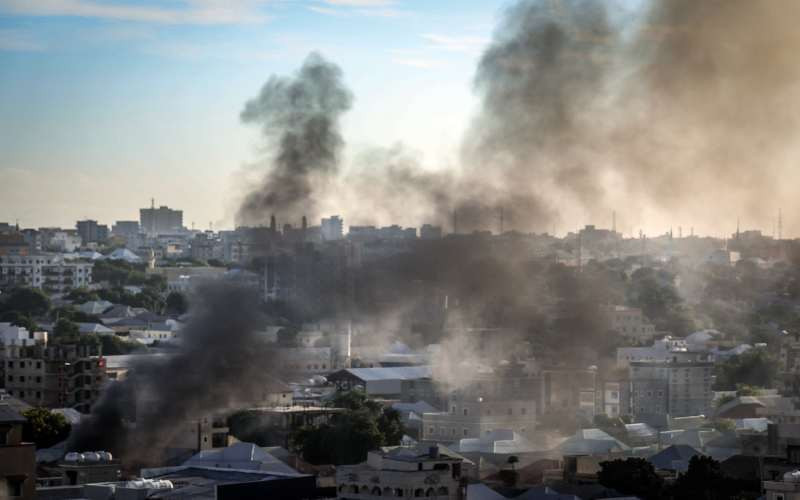
Heavy gunfire was heard through the night in Somalia's capital and smoke was rising over the city, AFP journalists reported on June 4, 2026. [AFP]
The African Union Commission (AUC) has condemned armed clashes in Mogadishu between opposition forces and state security troops, as the violence threatened to derail Somalia's fragile response to a regional Ebola emergency.
On Thursday, June 4, Opposition leaders accused security forces of attacking residences linked to former Prime Minister Hassan Ali Khaire and former President Sheikh Sharif Sheikh Ahmed.
"An attack was launched against us by forces commanded by the president whose term has expired," Khaire said in a social media post, adding they had been preparing for a "peaceful demonstration" the following day.
The AUC called on all parties to stop fighting, protect civilians and resolve differences through dialogue.
"The commission is deeply concerned by reported security developments in Mogadishu, including armed clashes in civilian areas," read the statement.
The violence compounds an already precarious public health situation. Somalia's health ministry had designated Martini Hospital in Mogadishu as the national centre for assessing and testing suspected Ebola cases, with officials coordinating prevention efforts across government ministries, civil aviation and international missions.
Armed clashes in the capital put that coordination at risk.
The World Health Organization (WHO) declared the Ebola outbreak affecting the Democratic Republic of Congo and Uganda a Public Health Emergency of International Concern on May 16, 2026, with 1,262 suspected and confirmed cases and at least 241 deaths reported by May 29.
The outbreak involves the rare Bundibugyo strain, for which there is no approved vaccine.
Somalia had no confirmed Ebola case, but officials warned that preparedness was essential given regular movement of people and flights from neighbouring Uganda and Kenya.
The government had urged all agencies to work together to prevent Ebola from reaching Somalia, coordination that now faces disruption from the political crisis.
Khaire accused Mohamud of deploying state security forces against political opponents and alleged that troops trained and equipped by international partners to fight al-Shabaab had been turned against opposition figures.
Mogadishu police blamed the violence on "organised attacks" by armed militias pursuing political interests, saying the clashes were "coordinated armed acts" that threatened the security of the capital.
Stay informed. Subscribe to our newsletter
One witness, Saleban Mahad, said the shooting lasted about 15 minutes. "They even used RPGs (rocket-propelled grenades), and the sound of the explosions could be heard across the surrounding neighbourhoods," noted Mahad.
The US Embassy in Mogadishu described the violence as "reckless," warning that "actions taken in the coming hours and days may have lasting consequences for Somalia's security, unity, and future."
The clashes follow Mohamud's announcement extending his tenure by one year after parliament passed a new constitution in March, a move opposition regional leaders rejected, prompting plans for mass demonstrations.

Subscribe to our newsletter and stay updated on the latest developments and special offers!






 join
join